
Showing posts with label mama diaspora. Show all posts
Showing posts with label mama diaspora. Show all posts
Tuesday, 2 February 2016


Thursday, 16 October 2014
Wednesday, 12 February 2014
Sunday, 20 October 2013
Saturday, 8 December 2012
Monday, 26 November 2012


Saturday, 6 October 2012

Friday, 29 June 2012
Saturday, 16 June 2012
Thursday, 31 May 2012
Modern Balkan Tunes - Mama Diaspora (from generationbass.com)
Sexxy Saturday Cumbia – The Diversity and Long Life of Cumbia
May 26, 2012 - Posted by El Guero Unico

... Extra-Estrada records features some of the best modern Balkan tunes. With this new one we come to the very popular sounds of Eastern European cumbia.
Sometimes I am asked the question “Don’t you ever get tired of cumbia week after week, day after day?” The answer is a resounding “No”. Believe it or not I do not tire. The thing about cumbia is that it’s in an ever-evolving process. Every week I encounter a whole new approach to the sounds of cumbia. Whether it be a remix of a classic from its respected country of origin or something completely new with elements of other genres or even elements I can’t pinpoint exactly the origin of. This puts all fear of nu cumbia dying to rest, for me anyway. I can’t tire of an ever-evolving sound, different tempos and crazy feats of creativity. I found for myself personally to attempt to use elements of genres I favor and mash them into the nu cumbia universe. This has been a personal challenge of mine that keeps me from feeling stale and uninterested in working on new projects. My personal sound comes from my influences of post-punk, new wave, and ambience to the likes of Eno and Bowie. Others take their own personal influences into the genre (if one can actually label it as a genre anymore).
One of the big things happening right now is the whole Andean respect. Will Eede is working on finishing up his new incredible Andean mixtape that I promise will move your soul. I can’t wait to be able to post it here but I have to respectfully wait until he’s ready. But others have tapped into this style very recently. One new to this blog in particular is Señor Griff.
Bunbepe - Compilation featuring Mama Diaspora's remix by DJ Derbastler
This week: hot digital cumbia from Bunbepe, disembodied dubtech from Capricorn Productions and futuristic jazz from Beautiful Swimmers & Don Cherry
Bunbepe
Let the sunshine in! oh. it’s raining now. Fuck it, I got my shades on & I’m feeling fruity. Just like my shades make me instantly feel stoned without having to put clipper to rizla, this sort of digital cumbia makes me instantly feel the late afternoon sun on my face, several mojitos down and several more still to come. Great selection here finishing on a tango note, heralding the impending night…
1. Faraón Bantú – Macaco Mata el Toro (Batata Remix) [feat. Nova Lima]
2. Ricardo Ray – Cabo E (disqueDJ Dub Bassucka Mix)
3. The Binary Cumbia Orchestra – Ydyay (Original Mix)
4. Celina Y Reutilio – Yo Soy El Punto Cubano/Moombah Diabolo Moombah Diabolo – Jon Kwest (Dj Reaganomics Remix)
5. Petrona Martinez – Sepiterna (Thornato Remix)
6. El Remolón – Lamento De La Selva (El Remolón Remix)
7. Bleepolar – Chiquita
8. Cumba Mela – Seu Maya (Thornato Remix)
9. Chico Ye – Menea
10. Barrington Levy – Here I Come (Live) (ELMAYONESA Remix)
11. Elo & Fokn Bois – Fokn Future (Frikstailers Remix)
12. Buraka Som Sistema – Burakaton (feat. Bomba Estereo)
13. Elo & Wanlov The Kubolor & Sena – My Skin (Hijo De La Cumbia Remix)
14. Mama Diaspora – Dub in Karpaty (Nu Cumbia Derbastler Remix)
15. Gotan Project – Santa María (del Buen Ayre) (Chancha Via Circuito Remix)
http://generationbass.com/2012/04/11/midweek-mixxxtapes-bunbepe-capricorn-productions-beautiful-swimmers/
2. Ricardo Ray – Cabo E (disqueDJ Dub Bassucka Mix)
3. The Binary Cumbia Orchestra – Ydyay (Original Mix)
4. Celina Y Reutilio – Yo Soy El Punto Cubano/Moombah Diabolo Moombah Diabolo – Jon Kwest (Dj Reaganomics Remix)
5. Petrona Martinez – Sepiterna (Thornato Remix)
6. El Remolón – Lamento De La Selva (El Remolón Remix)
7. Bleepolar – Chiquita
8. Cumba Mela – Seu Maya (Thornato Remix)
9. Chico Ye – Menea
10. Barrington Levy – Here I Come (Live) (ELMAYONESA Remix)
11. Elo & Fokn Bois – Fokn Future (Frikstailers Remix)
12. Buraka Som Sistema – Burakaton (feat. Bomba Estereo)
13. Elo & Wanlov The Kubolor & Sena – My Skin (Hijo De La Cumbia Remix)
14. Mama Diaspora – Dub in Karpaty (Nu Cumbia Derbastler Remix)
15. Gotan Project – Santa María (del Buen Ayre) (Chancha Via Circuito Remix)
http://generationbass.com/2012/04/11/midweek-mixxxtapes-bunbepe-capricorn-productions-beautiful-swimmers/
Tuesday, 29 May 2012
Thursday, 24 May 2012
Saturday, 12 May 2012
Mama Diaspora vs Yuriy Gurzhy
Their style is unique, their beats are
solid and groovy, their melodies and texts are moving

Mama Diaspora vs Yuriy Gurzhy is an
international musical act, involving musicians who have their origins in
diverse Ukrainian musical culture and arts. Their musical style is a international
Band-Global Beat, World Fusion, Tropical, Balkano Moldavano-New Wave, Dub.
Mama Diaspora vs Yuriy Gurzhy is a
relatively recent musical project as it is in existence for only three years, which
has already created and published two musical EPs in 2010 and 2011 and has
finalised a full studio album “DJ is Drunk” in 2011, featuring tracks “Secret
Agent” and “Back in My Hometown” that became part of musical compilations in
Ukraine, Italy and Germany. The musicians of Mama Diaspora – Ivan Derbastler (beats
and grooves), Evgeniy Didyk (trumpet) and Igor Sakach (guitar, vocals and
keyboards), as well as the vocal soul of the band, lyricist Yuriy Gurzhy, have an
extensive performance experience from their other musical projects.
Influences and inspiration
History of the group and its composition
The Mama Diaspora started with artistic collaboration
of Ivan Moskalenko (aka DJ Derbastler) and Igor Sakach (DJ Ingvo), having
been formed in 2009 at a music festival in Belarus. Both Ivan and Igor have a
profound background in music and performance experience.

Ivan Moskalenko (Derbastler) is well-known as a Ukrainian DJ, musician,
music producer, Ukrainian club and rave pioneer, and a legend of the Ukrainian musical
underground. He produced and mastered the earliest compilations of the
Ukrainian electronic scene including, Torba Sound 95, Who is Next, SALEction
2000, Music for Space Lorry Drivers. Ivan was also musical director for the
first rave Torba Partys 95-97, and founder of the underground projects Yarn and
Radiodelo. He has played in the bands Shake Hi-Fi, Electrics, Foa Hoka. He is
the co-creator of the Torba tapes, Sale! Rec, Thermos rec and Extra Estrada rec
independent labels. Since 1995, Ivan Derbastler has authored the soundtracks
for collections by clothing designer Lillia Pustovit, regularly taking part in
Ukrainian Fashion Week since 1998. Ivan has participated in many international
contemporary art forums: the Venice Biennale, Manifesta 5, the Palais des
Festivals at Cannes, the Vienna Academy of Fine Arts, the Soros Centre for
Contemporary Art in Kyiv, the Goethe Institute German Cultural Centre, the
National Museum of Ukrainian Art, the Pinchuk Art Centre and at a number of
international arts festivals. Ivan has closely
collaborated with such groups as Gogol Bordello and its leader Eugene Hutz,
RotFront and Yuriy Gurzhy, having produced remixes for the groups. Ivan’s
influence on the musical style of Mama Diaspora’s works is essential.

Igor
Sakach (Ingvo), born in
Novy Sad, Serbia, has played in such groups as Broigel, and after having
graduated from the Ukrainian National Academy of Arts in Kyiv, from a class of
double-bass, started being active on Ukrainian electronic music scene since
1995, playing jazzy house, deep and funky house tracks. He collaborated with a
number of Ukrainian jazz musicians, including Milosh Jelic of Okean Elzy on a
Digital Balkan project, "Balkan Groove System" featuring Yuliya Lord
and a Ukrainian folk group Bozhychi. He also collaborated as a keyboard player,
DJ and stage producer with Stereoliza musical group. Igor has a major influence
on composing, arrangements and musical production of the Mama’s records,
performing on guitar, keyboards and as a vocalist himself.

In March 2010 the group was joined by Evgeniy Didyk, a trumpet player with
extensive experience, diverse musical interests and a solid artistic
background. Evgeniy is originally from Moldova, where he studied at the
Chisinau musical conservatory, having graduated from a class of jazz and
classical trumpet. He started his career by playing in Kuibul musical group and
in 1999 he joined Zdob si Zdub, having contributed to recordings of the song
well-known to every person on post-Soviet territory - “Having seen the night”
(«Видели ночь») by Kino. Later on he collaborated with Ruslana and Free
National Band, having taken part part in the recording of Ruslana’s “Wild
Dances” album (Eurovision song contest winner in 2005). In 2006 he recorded
songs with the French group Red Cardell and
Bacя Club. He also closely
collaborated with Ukrainian folk pop group Sontsekliosh and participated in the
Haydamaky musical group, working on their three albums. Evgeniy’s input into
Mama Diaspora’s sexy jazzy sound gives a unique feel for the music of the
group, creating unbelievable emotions and warmest sensations from the smooth
trumpet jazzy sound.

Yuriy Gurzhy, a vocal soul of Mama Diaspora, became a
part of the musical act in 2010. He originates from Berlin’s musical scene,
coming there in 1995 from Kharkiv independent non-commercial music environment.
Since his arrival to Germany he was involved in DJ-ing, playing and composing
music. His creations were Russendisko, with a well-known writer and a close
friend Vladimir Kaminer. Recently Yuriy became more known as the leader for
energetic ROTFRONT Emigrantski Raggamuffin Kollektiv, started in 2003 by Yuriy
and Simon Wahorn uniting musicians of five different nationalities. The group
was declared to be the best world music act in Germany in 2009. As a DJ and
producer, he did remixes for Amsterdam Klezmer Band and wrote songs for Shantel,
including for the Shantel’s albums "Disko Partizani" and “Planet
Paprika”. He worked on creating several musical compilations for such
well-known labels as Trikont Records and Russendisko Records, being a director
of the last one. For Trikont he did a compilation of "Funky Jewish Sounds
from Around the World", within the framework of a project Shtetl
Superstars, and another more recent compilation in 2010 called “Revolution
Disco”. He has been an originator of charming and unforgettable poetry for Mama
Diaspora and his contribution to its music cannot be underestimated.
Date of
release of an album "DJ is Drunk": 2011
Genre:
Global beats, electronic world fusion, eastern nu cumbia, balcanomoldavano, new
wave, dub
Yuriy Gurzhy:
Singer, Lyricist
Igor (DJ Ingvo)
Sakach: Singer, Guitarist, Bassist, Groove-Maker, Producer
Ivan (DJ DerBastler)
Moskalenko: Groove-Maker, DJ, Producer
Evgeniy Didyk:
Trumpet player
International band
Label:
extra-estrada.com
Management
and booking: PK Pushkar (extra-estrada.com at e-mail: extra-estrada@smatsch.net)
Facebook page (http://www.facebook.com/MAMADIASPORA?sk=info):
Myspace
page: www.myspace.com/mmdiaspora
Soundcloud
page: Soundcloud.com/mama-diaspora
Tuesday, 17 April 2012
YURIY GURZHY: MUSIC CAN’T CHANGE THE WORLD ANYMORE, BUT MIGHT STILL HELP
YURIY GURZHY: MUSIC CAN’T CHANGE THE WORLD ANYMORE, BUT MIGHT STILL HELP
Yuriy Gurzhy is a Ukrainian-born musician and DJ living in Berlin, who won his fame as a founder and a DJ of Russendisko (Russian Disco) as well as the lead singer of RotFront band. His concert at the Klezmer festival in Furth required some re-tuning of the audience, since it was not really a concert, but another thing he is engaged in – a disco. The re-tuning was a piece of cake – the program labeled as Shtetl Superstars – Funky Jewish Sounds From Around the World had everything its name says and makes everyone dance, regardless of one’s age or cultural attribution. Yuriy Gurzhy on cultures, stereotypes, Russian disco and many more.


Ian: Yuriy, could you tell us a bit about the program for today. I’ve read the name ‘Klezmer disco’ and my first obvious association is ‘Russendisko’. Tell us a bit about what are we going to hear today.
Yuriy: Actually I keep on asking the organizers still from the first year of the festival not to label my part as ‘klezmer’. They always say ‘of course’ and keep on writing ‘klezmer’ in their program. So I decided not to pay attention to these conventionalities anymore. The program is going to be bright and diverse. I had this question from the very beginning, a rather rhetorical one, to which I either could not find any answer, of could find a whole bunch of. The question is what Jewish music really is and how can it be defined. In reality, it can be defined however you like and a lot of different musical directions can be classified as Jewish. There is a musicological term saying that it should be music somehow reflecting a certain Jewish experience; directly or indirectly, in music or in lyrics. On the other hand, it should be music written by Jews. In other words, there’s a lot of opportunities for interpretation. So I’m using these opportunities and playing things I just stumble upon. At the same time I have certain musical preferences which always emerge, both in Russendisko and in my own band RotFront. I am attracted by certain genres, certain instruments and try to compile the music set accordingly, so that it is harmonized both for me and the audience and danceable as well. It’s going to be like this today too. Of course, there’s a certain part of klezmer in there, which is even a significant part, but partially it’s really not klezmer, not really klezmer, or maybe even some kind of Israeli hip-hop. Well, may be, but won’t be. Actually classifying music is a dead frost today.
- Especially Jewish music..
- Not really, any music. There’s just good music and maybe bad music, which can still be alright though. So today we are going to have a real blast. The public is really grateful, at least according to the previous experiences here, so I hope on the mutual harmony.- Speaking about Jewish music. Would you call RotFront a Jewish music, and if yes, to which extent?
- This sends you back to the previous answer. Sure: it can be Jewish music, can be Hungarian, or can be Russian/Ukrainian. All these elements are present there. I came from Ukraine, speak Russian and also have a Jewish background. We can be attributed to any culture or style, but I hope there’s no term for this hybrid invented yet. In other words, there’s a certain number of the elements mixed, and as for me, mixed in a rather unique way. So surely, we can be called a Jewish music, especially today, on such occasion. We have songs on different topics, Jewish as well (shows his t-shirt saying ‘Gypsy, Jewish and Gay’).
- That’s actually something I was going to talk about. In this song, ‘Gay, Gypsy and Jew’ there are many bands involved besides RotFront itself, including Ukrainian band ‘Perkalaba’…
- Yes, ‘Perkalaba’ has recorded 42 tracks; I can imagine how happy our producer was having realized he has to work with 42 files for one song, and this is not the end at all…
- Everyone recorded separately?
- Yes, they recorded everything separately and then sent it. They are all based in their own countries and we don’t have any means to gather them all together, like it was done in the video clip ‘We Are The World’.
- There is actually a connection between the two songs. What’s the story behind this one?
- The idea was prompted by the events in Hungary, since we play quite often there. It’s getting really serious when start to you hear about the problems of certain minorities from people which do not belong to them. When minorities consider themselves to be oppressed, it’s still somehow subjective, but when others start to talk about this, something should be done. In Hungary, these three groups precisely are facing such problems. I thought that there are some clear commonalities and this is something I should sing about. I was always trying not to make any direct political statements.
- I didn’t find any political statements in the song.
- True, but it is still the most direct thing I’ve ever done. The song is partially based on Nina Simone’s ‘Young, Gifted and Black’, which has a reggae version as well. The chorus is influenced by ‘Hava Nagila’ and ‘YMCA’ by Village People.
- I was thinking what does the song remind me of…
- See, it reminds you at least of three tunes. I really enjoy putting not really direct, not really obvious quotations, since each of them is disclosing a different layer. It’s clear with Hava Nagila, it’s clear with YMCA as well.
- Indeed.
- I wasn’t trying to invent anything, it all just came by itself. This is a kind of song you sing all together. It sounds well live. Of course, music can’t change the world today anymore, but might still help.
- By the way, why most of your songs, like this one for example, are in English?
- You have probably listened to the new album, since the songs of the first one are mostly in Russian.
- I mean the hits first of all.
- Right. In reality it’s very pragmatic, since for some time we were singing exclusively in Russian, Hungarian and German. Meaning each one was singing in his mother tongue. Finally German remained, Hungarian remained there too, and Russian was put a bit aside, ‘cause I was singing more than all others. At this time we were touring quite successfully, when suddenly I received a phone call from Shantel from Frankfurt. He sent me the instrumental and asked to write the lyrics for it. He wanted it to be in English, and I wasn’t writing in English for a while, only when I was 15 or 16, in times of a terrible decadence in Ukraine, when it sounded appropriate to sing in English. Since then I thought it’s better to sing in one’s native tongue. But when I wrote the song for him, it appeared to be quite easy; it was actually the song ‘Discoboy’ which has its own, legendary fate now. We were singing the song live afterwards. Before that I thought that we have a perfect mutual understanding with the public of going crazy together. At the gig I realized that there is a different level too, that everyone understood everything in English, and our audience is not only Russian or Hungarian. This was a motivation for me to write more in English, to which I almost switched now, though now I write in Russian too sometimes. The main thing is that the audience should understand you.
- When I heard RotFront for the first time, it was the song ‘SovietoBlaster’. It seemed to me to be a sort of banter of all post-Soviet stereotypes…
- There is nothing Soviet in the song itself, and the clip doesn’t have any relation to us. Both clips were produced by a wonderful woman from the USA, Nathalie Lawhead. I’ve never seen her, she just sent us a mail saying that she’s our big fan and would like to make a video clip. I’ve looked through her other works and honestly, by that time I could not imagine how could this be combined with our work. I replied ‘of course, please’; it’s not everyday that people approach you with such offers; she requested the lyrics and in a month sent us the ‘Sovietoblaster’. The first impression was that she’s visualizing each line, but at the same time she’s chosen some weird bearded soldiers from Smolny, while there was nothing like this in the song. She sort of added things. So there was no banter neither in the song itself, nor in the very word ‘sovietoblaster’, a vague definition of some sort of device. Being involved in Russendisko for many years, I’m acquainted with such aesthetics and techniques, this ‘recycling of the past’. From the first moment it seemed to me that she just goes too far. Then I realized that it’s already beyond good and evil. For her it’s not a banter at all, she actually doesn’t know all those Soviet things. She just juggles with some elements she likes, and actually it’s her right and she’s done it in a great way.
- The clip seems to impress even more then the song.
- Indeed, and when she’s heard that there’s a song planned called ‘Gay, Gypsy and Jew’, which wasn’t even recorded by that time yet, she immediately said that she wanted to do the clip. It’s rare that you get to meet such people. The second movie clip is wonderful too, seems like there’s nothing Soviet in it, hopefully.
- There’s a common stereotype that many of Russian emigrants in Germany or elsewhere are constantly fixated to their background and are not really well integrated. Indeed, if you visit a random ‘nostalgic’ Russian store in Berlin, the stereotype is easily proved. At the same time RotFront is showing the bright, diverse side of the emigration culture. How does the artistic perspectives of Russian emigrants look like in general?
- Can’t really say. But for example, I notice more and more Russian authors in German and American literature. The future surely doesn’t belong to those who are fixated. The younger you are, the easier you find it to adjust to the new conditions. As for me, it’s the natural course of events, this is how it should be and this is how it actually happens. I see a lot of talented people coming to live in Germany and it’s great if they are well integrated.
- You are originally from Ukraine. It seem that often Germans, as well as others, don’t see any difference between Russians and Ukrainians and label everyone as ‘Russian’.
- You know, lately I realize more and more that Russian and Ukrainian are totally different people, even though they have a lot in common. I grew up in the USSR, grew up Russian-speaking and still remember the times when one could get exempted from learning Ukrainian for health reasons, just like it was with physical education. I almost don’t have a single Ukrainian-speaking friend. It took time for me to notice the difference in the mentality. The common language unites. Of course, for Germans we all are ‘relatively Russian’. But I think that it’s going to change too.
- You mentioned Russendisko. How did it all began?
- By a simple coincidence, like all the best things. Vladimir invited me to his place and I’ve seen his impressive collection of tapes and LPs. I asked him if I could take some with me. In a couple of days I came back again and we started to exchange and discuss LPs, tapes and books with each other regularly. Once I was there when we have received an offer to organize an event in Tacheles, in the legendary cafe Zapata. This was on the Novemner 7th, Russian Revolution anniversary.
- When was it?
- 11 years ago. Vladimir was a theater director and an actor, but his theater activity was almost in the past by then. So when we have received the offer, his spouse said: ‘guys, why wouldn’t you make a disco if you have so many tapes and disks’. So that was what we did. In reality, it appeared during the disco that our views on dance music were quite different from those of the audience. But from a certain moment everything went smoothly. There were people from Kaffee Burger there, which wasn’t open yet, but was already acquired. They offered us to do such events on the regular basis. That’s how it started. In half-year from then Vladimir Kaminer has published a book of his short stories, and he needed to find the name. The name was on the surface. And it’s already on Wednesday that we’re playing with RotFront on the Russendisko movie premiere, based on his book. It’s a giant German project with a very popular young German actor Mattias Schweighofer playing young Kaminer. It’s being advertised all over Berlin and Germany.
- Seems like Russian emigrant culture is probably even more interesting to Germans then to Russians…
- Actually there’s no connection between the book and the emigrant culture. The book is originally written in German and for Germans. Even though in this book Kaminer writes about Russian, his next one, for example, is dedicated to his journey through the German countryside.
- Still, in TV shows he is always being presented exclusively as ‘Vladimir Kaminer, Russian author’
- ‘True, but he is also often invited to Jewish festival, where he is ‘Vladimir Kaminer, Jewish author’, and when he goes to Russia, they offer him an interpreter and announce him as a ‘German writer’. I don’t care about such things anymore. Once I was always correcting others, like ‘we are this, and not this by any means’, or ‘this one is good, but this is not what we are’. Whatever. Let it be any culture, even African. There might be actually some connections with this one, by the way.
Friday, 24 February 2012
Tuesday, 31 January 2012

Monday, 30 January 2012
ПРОШЕДШИЙ КОНЦЕРТ MAMA DIASPORA VS YURIY GURZHY В КИЕВЕ
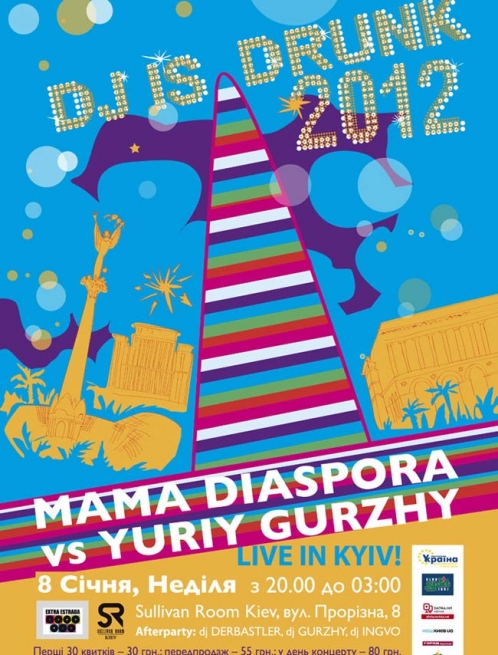
Стирая какие-либо границы этот бенд можно назвать интернациональным, и по музыке и по месту жительства. Сегодня они в Киеве, завтра мы уже смотрим репортажи из Берлина и Будапешта, а послезавтра из Амстердама или Лондона … И отовсюду звучат знакомые мотивы в стиле Global Beats и Electronic, WorldFusion и Eastern NuCumbia, Balkano-Moldavano — NewWave или Tropical, Dub и т.д. …
Итак, вернемся в 2009 год, когда на музыкальном фестивале в Беларуси познакомились Иван Москаленко (dj Derbastler) и Игорь Сакач (dj Ingvo). Каждый из них уже был достаточно известен на музыкальной арене.
Еще в 90-е годы Иван Дербастлер начал свою музыкальную деятельность в группах - Электрики, Ярн, Радиодело, а также в незабываемом для киевской сцены бенде – Shake Hi-Fi, вместе с Виталием Улицким запустил популярный проект Torba Entertainment, с художником Кириллом Проценко создал арт-медиа проект Radio-Eurasia, является автором музыкальных сборников, которые сопровождают дизайнерские показы одежды Лилии Пустовит и еще много других интересных проектов. В проекте «Мама Диаспора» - композитор, диджей, продюсер.
Игорь Сакач, родился в г. Нови Сад в Сербии. В поиске сильной музыкальной школы в 1994 году Игорь приехал в Киев и поступил в Национальную Академию Искусств им. П.И.
Чайковского. С 1998 года - увлекся электронной музыкой и dj-деятельностью в стиле jazzy house, deep and funky house и начал работу в качестве dj в «Club 44», сотрудничал с
Digital Balkan и Милошем Эличем (клавишник из группы «Океан Ельзи»), а также работал в проекте «Balkan Groove System» с Юлией Лорд. В проекте – композитор, гитарист,
басс-гитарист, вокалист, продюсер.
Идея создания группы настолько захватила ребят, что уже через несколько месяцев Киев танцевал под звуки зажигательных, удивительно трогательных и, вместе с тем, волнующих песен в стиле балканской народной музыки с основой dub и elector beats, под песни новой группы "Мама Диаспора" с уникальным вокалом Юрия Гуржи, "нашего человека из Берлина". В проект Юрий был приглашен не случайно, поскольку он безоговорочно является одним из самых известных и талантливых исполнителей украинского происхождения, за плечами которого такие проекты, как Russendisko, Rotfront Emigrantski Raggamuffin, работа с Amsterdam Klezmer Band, Shantel, создание множества музыкальных сборников и проектов. В проекте – вокалист, автор стихов.
И вот, по прошествии нескольких месяцев, нас ждал новый сольный концерт Мамы Диаспоры в одном из лучших киевских клубов. Ребята вновь приятно удивили нас не только новыми песнями, но и игрой виртуозного трубача Евгения Дидыка, в послужном списке которого работа с «Гайдамаками», Zdob si Zdub, Русланой, Free National Band и многими другими.
Гармонично влившись в коллектив, Евгений внес новые нотки в жизнь группы. В проекте – трубач.
Subscribe to:
Posts (Atom)